

Stop the Clocks

My fascination with timers grew from an attempt to correct a weakness and seize an opportunity for self-improvement. A number of years ago, while doing long hours as an assistant, I was struggling to find time to practise my editing. I would try to assemble scenes in my free time, but that free time was sparse — and often, just as I was getting familiar with the footage and beginning to form a vision for a scene, I’d get a call for a playout or some sound work, and all my progress would be lost. Rarely did I manage more than an hour to myself in a day.
The other challenge was applying the discipline of an editor to my own work. A working editor has to assemble scenes by the end of the day or face a backlog — but as an assistant cutting scenes in my spare time, there was no pressure, no deadline, no one waiting on a delivery. I could languish in the artistic process for days. Scenes would often be left unfinished.
I needed to set myself a challenge. I knew that, no matter how busy the day was, I could always free up one hour without neglecting my duties. So I challenged myself to take one scene each day and fully assemble it within that hour. The beauty of this was that it removed any pretension from the process — it was about focusing on speed and a basic efficiency that my previous, open-ended approach had never allowed.
To help, I decided to get myself a stopwatch.

The Stopwatch
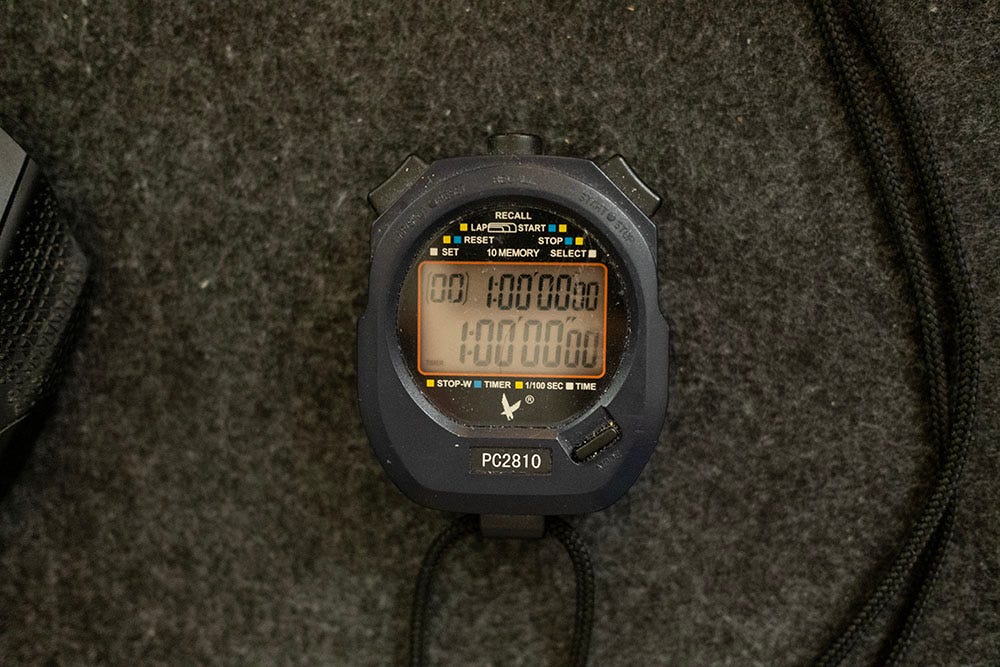
I went online and bought the biggest, chunkiest, PE-teacher stopwatch I could find — it even came with one of those whistles with a peanut in it. By modern standards it has very little functionality, but for me it’s exactly what I need: a fat, chunky-buttoned basic digital display, set to count down an hour with loud beeps at the start, stop, and on the hour. It still sits to the right of my desk and travels everywhere with me. Sometimes I forget to reset it at the end of the day and it beeps through the night, clocking up multiple hours until I arrive at my desk the next morning.
One glorious advantage of this old reliable tool: unlike most of my tech, I don’t need to charge it four times a day. In over ten years, I’ve changed the battery exactly once.
The Hourglass
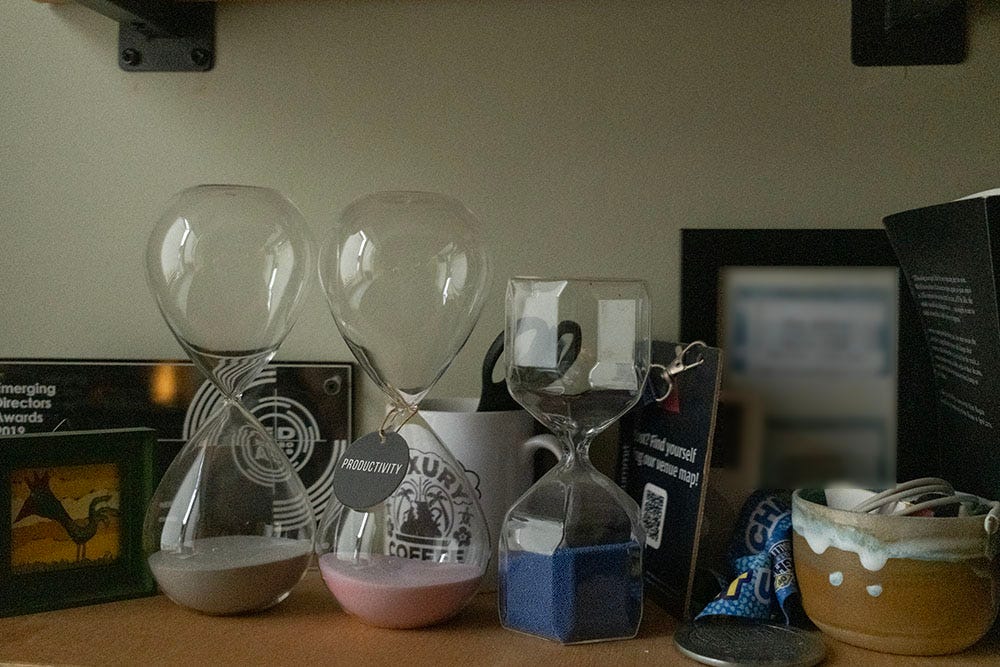
I also keep a small collection of hourglasses in my edit suite. There’s something wonderfully visual about them — watching the sand slowly fall over 15 or 30 minutes gives you an immediate, tangible sense of time passing. There’s a tactile pleasure in flipping one over as you begin a job.
My favourite was a beautiful hourglass from the gadget shop in Selfridges — simple, but with a lovely weight and feel. I was gutted when, on bringing it to Dublin for a short film I was cutting, I opened my suitcase to find my clothes coated in fine, glittery sand and the hourglass in pieces beside them.

The iPhone
And of course, there’s always the trusty iPhone timer. Nothing wrong with it at all — it’s quick, it’s always in your pocket, and you can run multiple timers simultaneously. While there are countless apps and gadgets I could happily spend money on and abandon within a week, there’s something reassuringly simple about the built-in stopwatch.

Overall Takeaways
I love the gentle self-pressure that a timer brings to my working day. I time myself on a wide variety of tasks and find that small nudge of urgency genuinely helps me push through. It’s also a brilliant way of understanding how long things actually take — useful knowledge for planning any project.
One of my favourite approaches is dividing a set amount of time across a list of tasks or notes, giving each one a time limit. You don’t always hit every target, but aiming for something is a great motivator in itself.
Timers are also invaluable on the days when you’re just not feeling it. I’ll often give myself an hour to do as much of a dreaded task as I can, with a break as the reward at the end. You’d be surprised what you can get through — it’s gotten me past many a mundane task on an unmotivated afternoon.