

Working from Home
In recent years, the popularity of remote work has surged. I looked at how this move has affected two drama editors.

This article first appeared in the Irish Screen Editors Assembled Magazine, March 04. Assembled is a magazine, free to all and available at the Irish Screen Editors website.
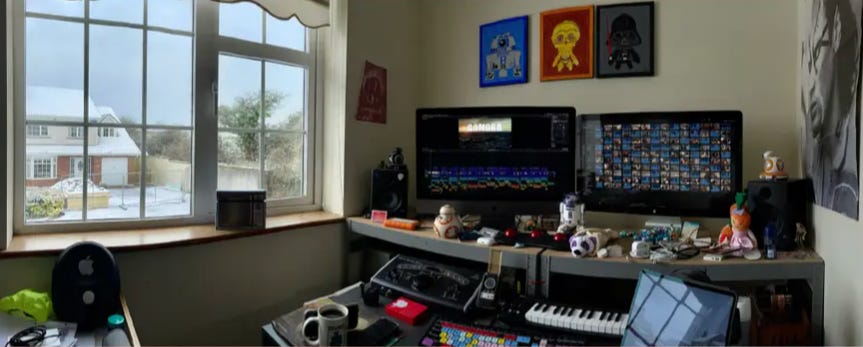
In recent years, the popularity of remote work has surged, driven by the Covid-19 pandemic and advancements in technology that enable various industries to reduce their dependence on centralised offices. As the initial rush to work from home post-pandemic subsides, many industries are now seeking the optimal balance between a centralised office environment and remote work.
Historically, the concept of working from home was not a practical option for editors and post-production professionals. The substantial volume of media and the necessity to screen and collaborate with directors, producers, and other creatives made the idea of working from an editing suite in one's back garden or home office financially prohibitive and impractical for many. However, recent improvements in home wifi capabilities, enhanced file transfer tools, and the availability of streaming and remote desktop services have transformed the feasibility of remote work for editors, making it a much more viable reality.

Daniel Greenway, for one, appreciates the producers' increasing openness to allowing editors to work from home. Greenway is a BAFTA and RTS Award-nominated British drama editor with credits that include The Crown, The Terror, and Humans. Most recently, he edited The Crown’s final episode, "Sleep, Dearie Sleep," a lot of which he assembled in his house in Hitchin, just outside London.
“I’m in a separate building, we’ve got a garage that’s been converted into an office so it’s completely separate from the house. It’s really nice to get to walk out of the house and shut the door and get fresh air. It’s my own space and I’ve got really nice kit set up now that I miss whenever I go into town and have to use the rented stuff.”
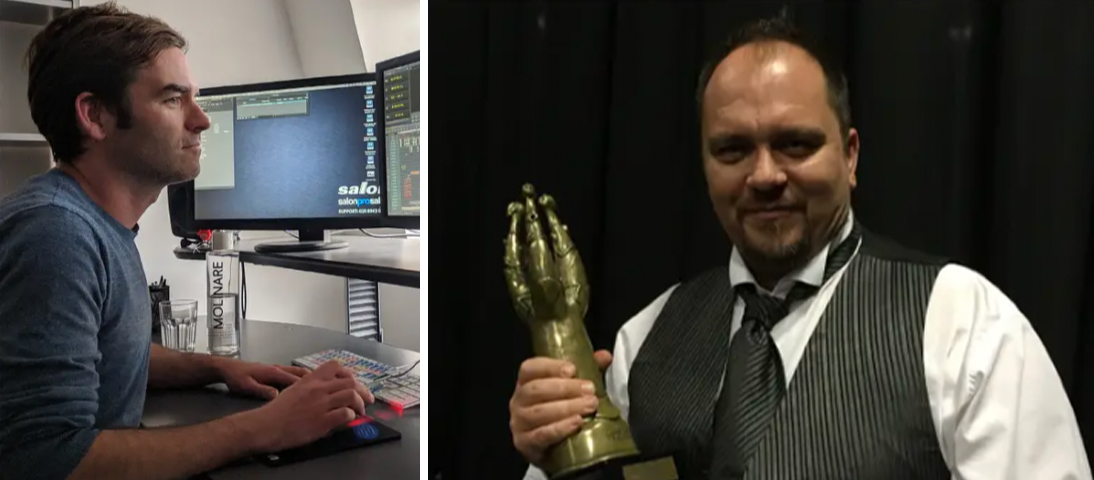
Jeremy Briers, ISE “Please, call me Jayce” works from his house in Youghal, Cork. Jayce was born in the UK and spent most of his career working in South Africa before moving to Ireland in 2016. He has edited hundreds of hours of television, and his credits include Zulu Wedding and Jewel. “We never planned to live in Ireland. Being born in the UK I had always planned to move back there some day but my wife was South African and UK spousal immigration regulations were such a nightmare that we moved to Ireland while we waited for the visa. We loved it so much we ended up staying and have been here for just over 7 years.” What in particular made him choose Youghall? “We didn’t choose Youghall, Youghall chose us! We looked for places all over Ireland and the only agent who ever got back to me was an agent in Youghal.”
90% of the productions that Jayce works on are produced outside of Ireland. “It can get a bit crazy at times. Over Christmas 2022 I had 3 jobs all come in at the same time due to production issues. There were a couple of weeks where I was tunnelling into a clients computer in New York doing a 10 hour shift on Avid and then logging into an older client in South Africa for 10 hours working in Premiere then on the weekend doing a Netflix gig on my own system in FCPX. I do not recommend it.”
Are there any downsides to editing from home for Greenway? “Yeah, it’s fun to be with the director and to get lunch and a beer occasionally. And to mingle with other editors is really important. So ideally, for the fine cut at least, the ideal model is to work for two or three days a week centrally and then have a couple of days working from home on the notes. I’d love to do that. But while the director is shooting and I’m assembling the episode, I prefer to work exclusively from home. I’m always pushing for that kind of model. That would be ideal.”
“I’ve always had some sort of a setup at home. When I was starting out I was always cutting shorts from home, doing a lot of freebies. So I’ve been editing at home since I started out, really.” But it was on The Widow, an Amazon Prime series starring Kate Beckinsale and Charles Dance, when Greenway first encountered working from home on a bigger scale. “The Widow was shot in South Africa and we had a South African assistant who would be sending back rushes each day. So she would send me the rushes and the bins. That was where I first adopted the system of manually copying folders of .mxf media back and forth between the editor and the assistant on a secure file share system such as Aspera.”


Greenway’s preferred system involves manually renaming or “locking off” Avid MediaFiles MXF folders and then sharing between various edit suites. “You do have to be quite technically precise because ideally, if you want to be able to pop from your home office into the edit suite in London, or you want your assistant to do a playout, you just want to have a mirror of your media on that computer. So you need everything to be labelled, date every folder so that you can immediately see if you’re missing something, and every time that you want to playout, you will need to send your renders and to date your renders so that everything is online for the assistant. It requires a lot of discipline from people at both ends. “When this system breaks down it can get complicated very quickly. Recently I’ve done some documentaries which involved sharing media with the director at home. We used this system and we’d find out weeks later that there were bits missing. So you've got to be pretty organised.”
Jayce’s first big remote job was in 2016 “At the time I owned a post facility with about 5 suites, colouring and final mix suites and a few people working with me. When the opportunity arose to move back to the UK it was half way though a production of 13 episodes of scripted drama for TV. I had to make assurances to my client that working remotely would not hinder the show. I did extensive testing with proxies and workflows beforehand. Our initial workflow was having an assistant generate proxies and dropbox them to me.”
“In the UK we moved around a lot. So we had a challenge in making the files small enough to work over lousy rural wifi. At one point I was abusing McDonalds wifi so much that I felt guilty and had to go across the road to Pizza Hut. When I first moved to Youghal I was using mobile 3G and a laptop in my car close to the 3G tower.

Managing media becomes one of the most complicated tasks when working from multiple locations. In recent years, a variety of services and systems have emerged to assist editors and productions with their offsite media management. One of the most popular among these services is SalonSync, invented by Salon co-owners Nick Long and Nic Castle in the initial weeks following the onset of Covid. They were set a daunting challenge by the producers of The Great British Bake Off.“We had always provided kit hire to GBBO but the producers came to us with a challenge and said ‘Look, its a secret at the moment but the nation needs Bake Off more than ever to get everyone out of the gloom of Covid! How can we link up all our editors across the UK on varied internet from a few mb to a few Gb…and also our facility Nexis. The traditional methods of remoting in would have worked for some but about half, at the time, had such bad connectivity that our system was the only way. With the editors on poor connections they could use the night time to get rushes, it all comes through automatically; and then edit during the day. The only other option would have been sending hard drives but most of the edits were split between loads of very far flung places so it just would have been cost prohibitive, it’s fairly fast turnaround and all editors switch between eps so sending hard drives would have been an issue.” SalonSync grew from there “We currently service clients in the America’s, across Europe, Australia and even South Korea. We have around 20 SalonSync boxes in Ireland at the moment, of all various sizes. Last year we installed our first SalonSuperSync in Dublin which is 288TB of storage, it’s a big project and it will link to editors in many locations.”
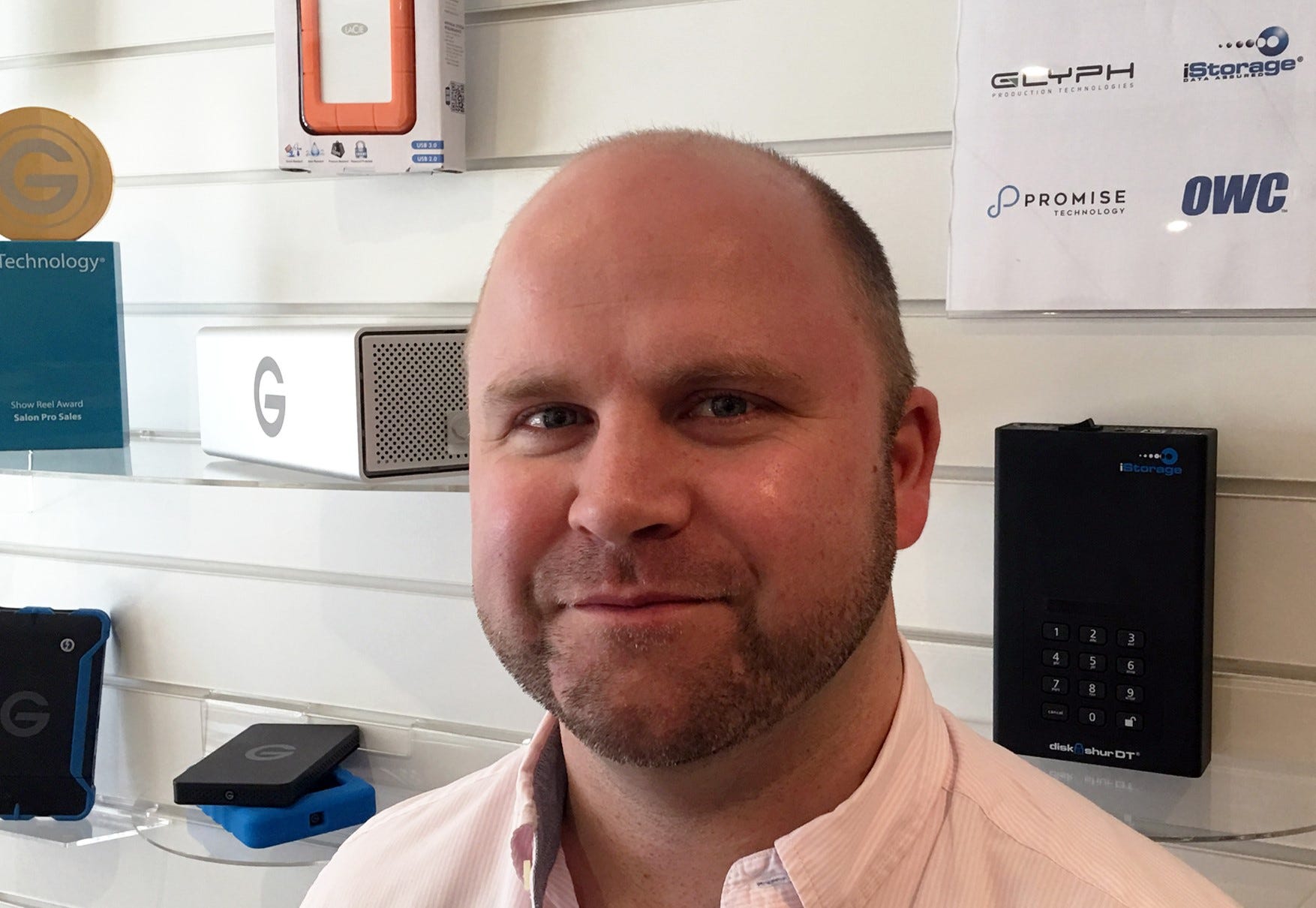
“One thing I have always said is SalonSync is not the only solution and we don’t want to become known purely as the box people! We at Salon offer a whole host of solutions from SalonSync through to remote access (Teradici/Jump Desktop and cloud based edit stations), it all very much comes down to workflow, what editors prefer and most importantly now connectivity.”
Connectivity is definitely one of the biggest issues. “I have 2x1 gig lines coming into the house.” says Jayce “I am currently working on a show of 6x20 minute episodes of scripted TV drama. It's shot on the Sony Venice and it’s 32 terabytes and counting but we are going strong.”
“I pay for business broadband,” says Greenway “A lot of the domestic broadband operators offer good download speeds but you want to make sure that if you need to upload something that the upload speeds are good also. You can run into problems at certain times of the day if you need to upload something to the assistant or to stream on Evercast or another streaming platform.” Not getting the best internet package is also the number 1 mistake made by editors working remotely in Nick Long’s opinion. “Connectivity has become one of the most fundamental tools of the trade now so where possible people need to make sure they have the best and most reliable package at home. “

Time management is something that many editors (and, let's face it, producers) have always struggled with, and working from home can often make this challenge more difficult. “I, like many of us, have trouble saying no to jobs” says Jayce “But I try not to to take on too much work. The main advantage to not being in a suite somewhere, I think, is that my time is more my own so if I have to nip off to do a personal errand then I can do that. The disadvantage is that sometimes it feels like I am always working as the office is right next to the bedroom.”
Greenway is keen to point out that each production is very different and requires a different mindset. “I try to make it clear, when talking to the director and the producers at the beginning of the the job, that this is what I ideally like to do. And I just say that I work fast and that I use the time well. I make sure that my assemblies are well finessed. And if you’re on the level, people will respect you a lot more if you’re honest and upfront about how you like to work.”
On a production like "Suspicion," an Apple TV+ project on which Greenway worked for two years amidst the challenges of Covid, Daniel had little other options. From March 2020 until the final picture lock in 2022, Daniel worked exclusively from home. Director and showrunner Chris Long was content providing notes on the cuts through streamed viewings on Evercast and by watching Quicktimes and providing written notes. “I like to take notes, and then spend time trying things out on my own and trying different things, having that time to come back and re-watch and come up with new ideas. And it actually worked quite well without having someone sat there in the room with me on Suspicion, and Chris enjoyed working this way also. But depending on the people involved; and for screenings in particular; it can be better to be in the room and to get a feel of the atmosphere .” Chris Long stands in contrast with Peter Morgan, writer and showrunner on The Crown “Peter likes to drop in and just say ‘show me something’. And then just watch and respond. And he does that while you're assembling. So that is not great for something if you're not ready. So you’ve always got to have stuff up your sleeve that's ready to be viewed. He really likes editing, because he thinks it's closer to writing. ”
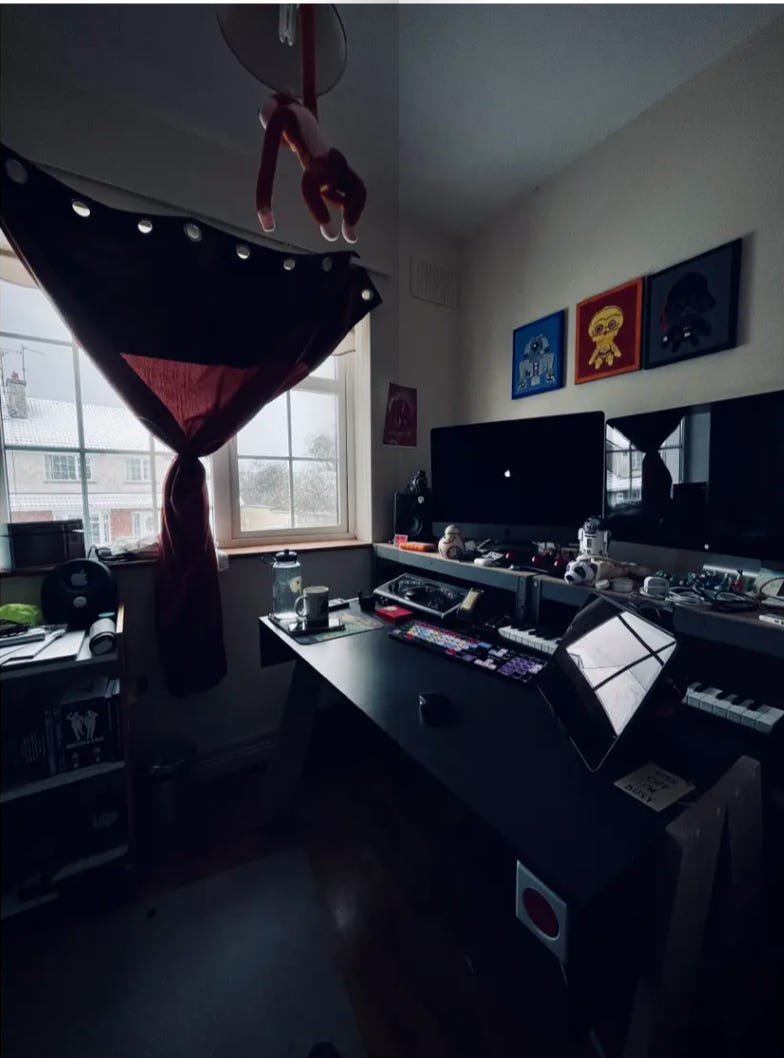
Does Jayce think he’ll ever go back? “I have just finished a short film with a friend of mine. I went over to London for the shoot and afterwards she came over for a couple days and sat in the 'edit suite'. And that’s what I miss. That direct connection with the director in a room. There have been a few occasions where I have thought about relocating to Dublin or there-abouts (I am not planning on leaving Ireland any time soon!!!) but I lay down until the feeling passes. I am happy to continue working this way as long as I can but yeah, I really do miss the room. On the other hand, there’s a director from South Africa who I have worked with for almost 14 years now and over the last few years we've finished 3 features and 4 TV shows together all remotely from my humble little seaside suite.”